

Choosing an Entity for Your Business
Presented by David Berman
Whether you’ve been in business for years or you’re launching a start-up, choosing or changing your
business’s entity is an important part of its financial and overall future.
A business’ entity determines the rules that govern its formation, operation, taxation, and dissolution. Its
entity also establishes the degree to which the business and its investors are liable for the acts of an
agent of the business. The entity you choose for your business will affect future financial business
decisions, like the need for additional insurance to protect yourself against liability or the decision to sell
ownership interests.
Entity Attributes
When choosing an entity for your business, you will want to consider the attributes of each type of entity
and which best fits your vision for the business. There are seven primary entity attributes:
- Formalities of existence. There are certain requirements and procedures involved in forming and
maintaining the entity. The fewer formalities of existence, the simpler and less expensive the entity. So, if
you want to avoid spending a lot of money forming or maintaining your business, consider an entity that
has few formalities of existence. - Limited liability. An entity offers limited liability if an owner can lose nothing more than their
investment. In other words, the owner’s personal assets are insulated and cannot be used to satisfy the
entity’s liabilities (debts). If you do not wish to put all of your personal assets at risk, think about an entity
that offers limited liability. - Pass-through taxation. In a pass-through entity, only the owners are taxed, not the entity. A separate
taxpaying entity, on the other hand, may be taxed on the same profits twice; the entity is taxed on its
profits, and then the shareholders are taxed when (or if ) these profits are distributed to them as
dividends. This is known as double taxation, and its existence is the main reason business owners
choose a pass-through entity. If you plan to have the profits of the business distributed as soon as they
are earned, or if you want a business that will permit you to deduct business losses from your personal
income, consider a pass-through entity. - Centralized management. An entity has centralized management if a person or a relatively small
group of people is responsible for management decisions. If you plan to give only a few people decisionmaking
power, which usually results in quicker decisions, choose an entity with centralized management. - Flexibility in sharing profits and control. Some entities are more flexible than others in sharing
profits and control with their owners. Depending on the flexibility, an entity can sell its stock to any
willing buyer, issue classes of stock with differing rights regarding the distribution of corporate profits
to shareholders, or issue stock with different voting rights. If you want to have control over how profits
are distributed and who has control over the corporation, you should choose an entity that allows you
this control. - Community of life. Some entities can exist forever. This is called continuity of life. An entity does not
possess this attribute if the death, bankruptcy, retirement, insanity, or resignation of an owner can cause
it to end (dissolve). Continuation of the business can be planned for, so while this isn’t necessarily a real
problem, it is something you should be aware of and consider. - Free transferability of interests. You should consider the ease with which ownership interests may
be transferred. Free transferability of interests exists when owners are permitted to sell their ownership
interests to others without restriction.
What Are the Primary Types of Entities from Which You Can Choose?
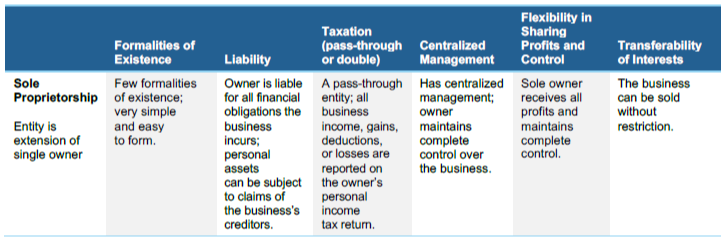
Sole proprietorship. The most straightforward way to structure your business entity, a sole
proprietorship is easy to set up—no separate entity must be formed. The business is simply an extension
of the sole proprietor.
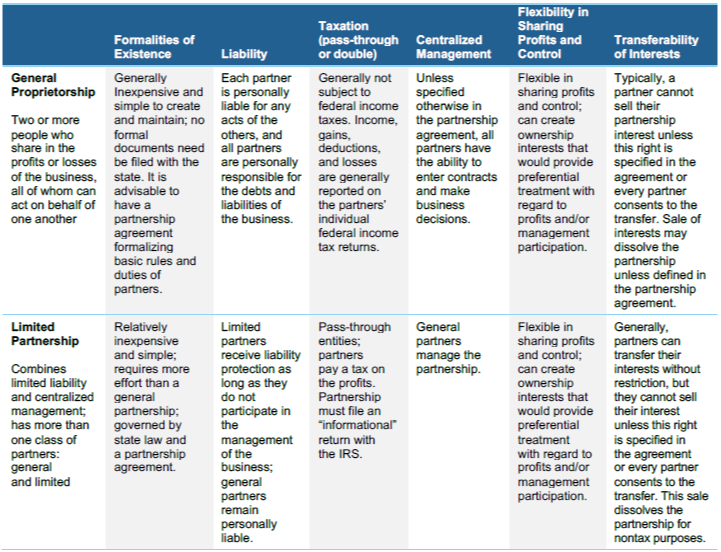
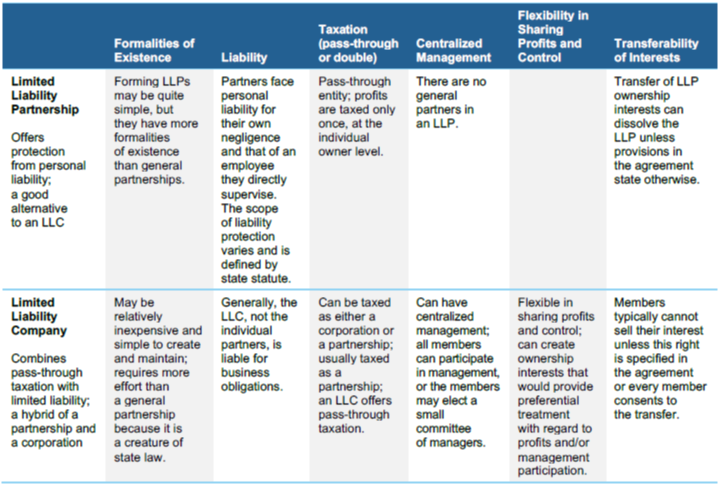
Partnerships. If two or more people own a business, then a partnership is a viable option to consider.
Partnerships are organized in accordance with state statutes. Certain arrangements, however, like joint
ventures, may be treated as partnerships for federal income tax purposes, even if they do not comply with
state law requirements.
A partnership may not be the best choice of entity for a business that anticipates an initial public offering
(IPO) in the near future. Although there are publicly traded partnerships, most IPO candidates are
organized as corporations.
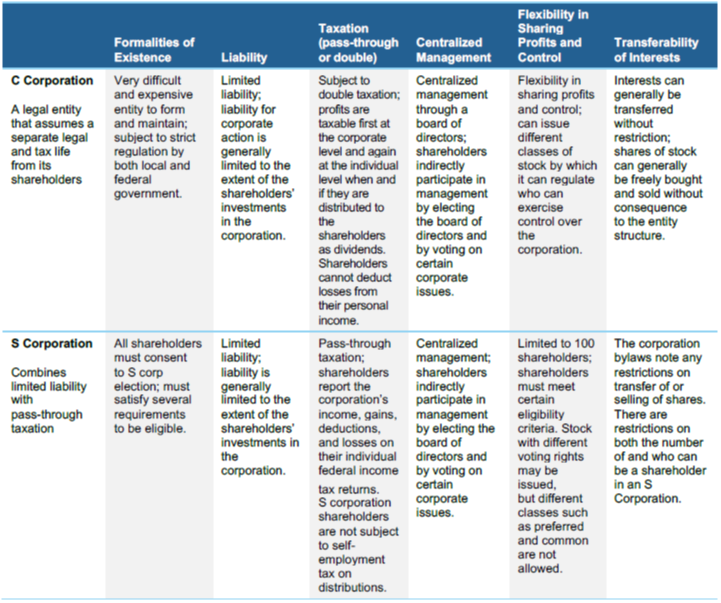
Corporations. Corporations offer some advantages over sole proprietorships and partnerships, but they
also come with drawbacks. The two most important advantages are that corporations provide the greatest
shield from individual liability and are the easiest type of entity to use to raise capital and to transfer
interests. (The majority stockholder can usually sell his or her stock without restrictions.) Corporations are
generally subject to federal income tax, however, so the distributed earnings of your incorporated
business may be subject to corporate income tax, as well as individual income tax.
Choosing the Best Form of Ownership
There is no single best form of ownership for a business. Often, the limitations of a particular form of ownership
can be compensated for through other means. For instance, insurance can reduce liability exposure if the
chosen entity does not provide this kind of protection. Even after you have established your business as a
particular entity, you may want to reevaluate your choice as the business evolves. We can work with an
experienced attorney and tax advisor to help you decide which form of ownership is best for your business.
This material has been provided for general informational purposes only and does not constitute either tax or legal advice. Although
we go to great lengths to make sure our information is accurate and useful, we recommend you consult a tax preparer, professional
tax advisor, or lawyer.
© 2026 Commonwealth Financial Network®