

Is the SIMPLE IRA the Best Retirement Plan for Your Business?
Presented by David Berman
As an employer with 100 or fewer employees, you have the ability to establish a simple and cost-effective
retirement plan for you and your staff. There are a few options available, but one you may want to consider
is the Savings Incentive Match Plan for Employees, commonly known as a SIMPLE IRA. This plan type is
an attractive recruiting and retention tool for highly compensated employees who are deterred from
traditional 401(k) plans due to discrimination testing.
What Is a SIMPLE IRA?
A SIMPLE IRA is an employer-sponsored IRA set up for employees. Contributions to the plan can be
made by employees and the employer.
Who Can Set Up a SIMPLE IRA?
This type of IRA is suitable for corporations, partnerships, sole proprietors, and tax-exempt or government
employers with 100 or fewer eligible employees.
Features of a SIMPLE IRA
- SIMPLE IRAs are low-cost plans that are easy to establish and maintain because there are
minimal IRS filing requirements and no annual compliance tests. - Unlike some other retirement plans, SIMPLE IRAs are not required to follow certain
Internal Revenue Code rules that prohibit discrimination in favor of higher-paid workers. - Employers must make the plan available to any employee who received at least $5,000 in
compensation during any two preceding years and who is expected to receive at least $5,000
in compensation during the current calendar year. - Employee deferrals and employer matching contributions are made to the account. Employers have
the option of contributing employee deferral matches or nonelective contributions.
Maximum Annual Contribution Limits and Rules
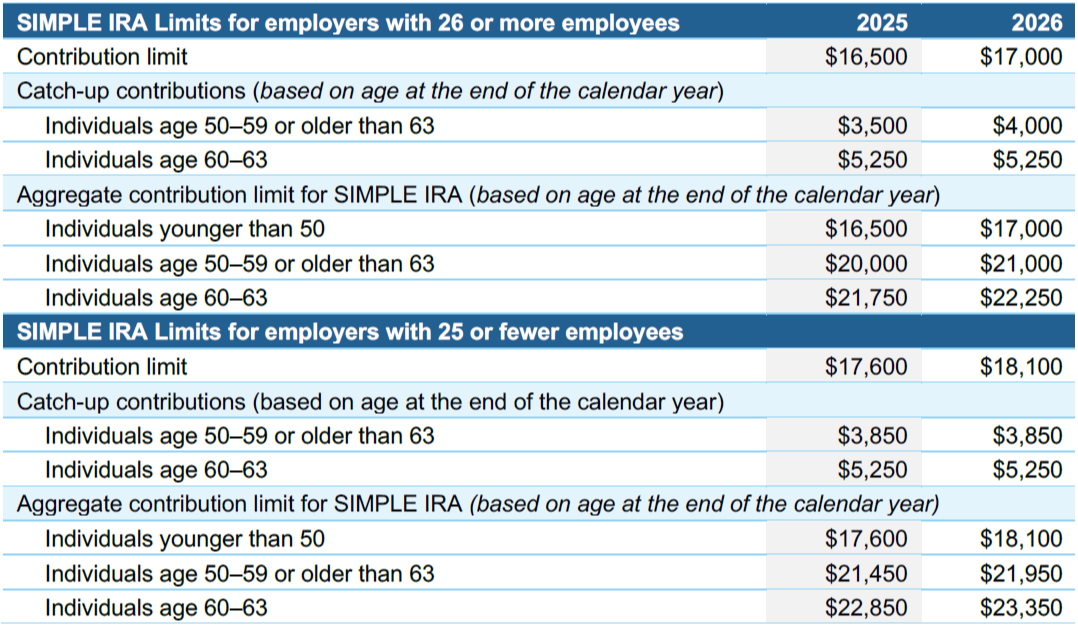
Notes on SIMPLE IRAs: Employers with 26 or more employees can take advantage of these larger limits
by increasing the employer contribution formula in the adoption agreement to a 4 percent matching
contribution or a 3 percent nonelective contribution. Employer must match deferrals dollar-for-dollar, up to
3 percent of compensation (can be reduced to 1 percent in two out of five years) or make a 2 percent
nonelective contribution to all eligible employees. Employers can also make an additional nonelective
contribution of up to 10 percent of compensation, not to exceed $5,300 per eligible employee. This
optional contribution is in addition to the required employer contribution.
Employers are required to contribute to employee plans and can select from one of two options:
- Match each employee’s salary deferral on a dollar-for-dollar basis up to 3 percent of the
employee’s annual compensation (not limited by the annual compensation limit). - Make nonelective contributions of 2 percent of the employee’s annual compensation up to the
annual compensation limit set by the IRS.
The first is a mandatory match for only those employees who make salary deferrals into the plan,
whereas the second is mandatory for all eligible employees, regardless of whether they make a
contribution to the plan.
Important Considerations
Please keep in mind that no other retirement plan can be offered concurrently with a SIMPLE IRA.
SIMPLE IRAs also have a unique two-year rule that prevents assets from being distributed or rolled
over too soon. For a participant younger than 59½ without a premature penalty exception (see below),
the 10 percent premature penalty increases to 25 percent if it’s been fewer than two years since the
first employer contribution was made into the account. If the participant is older than 59½ and within
the two-year time frame, no penalty applies.
Lastly, SIMPLE IRAs can be rolled into other SIMPLE IRAs only within the two-year time frame. Any
rollovers into other types of retirement plans, such as traditional IRAs, SEP IRAs, and 401(k)s, can be
made only after two years.
Distribution Rules
SIMPLE IRA distribution rules generally are the same as traditional IRA rules, with the exception of the
two-year rule. Distributions are taxed at current income tax rates in the year of distribution. If the
employee is younger than 59½, the premature distribution penalty of 10 percent may apply (25 percent
if within the two-year rule). Exceptions to the premature penalty are as follows:
- Reaching retirement age of 59½
- Death of participant
- Disability of participant
- Qualified higher-education expenses
- Qualified first-time home purchase (up to $10,000 per lifetime)
- Unreimbursed medical expenses (greater than 10 percent of adjusted gross income;
10 percent if younger than 65) - Health insurance premiums paid while unemployed
- Series of substantially equal periodic payments (e.g., SEPP or 72(t) plan)
For employees age 73 and older, required minimum distributions must be taken annually, even if they
are still working.*
* For individuals born before July 1, 1949, RMDs must begin at age 70½. For individuals born between July 1, 1949, and December 31, 1950,
RMDs must begin at age 72. For individuals born between January 1, 1950, and December 31, 1959, RMDs must begin at age 73. For
individuals born on or after January 1, 1960, RMDs must begin at age 75.
Getting Started
Required documents vary by institution but usually include an adoption agreement and IRS Form 5305
or 5304. Form 5305 means the entire plan and all participant SIMPLE IRAs are established at one
institution, whereas Form 5304 allows the accounts to be established at different institutions. A
SIMPLE IRA must be established between January 1 and October 1 of the calendar year. A 60-day
notice must be given to all eligible employees, offering them the right to make a salary deferral
contribution for the year or to modify a previous election.
SIMPLE IRAs offer a way to take advantage of the benefits of a qualified retirement plan for your
employees without having to deal with the complicated tests and filings required to maintain one. They
are a great incentive for your employees and a great way to save for your retirement!
This material has been provided for general informational purposes only and does not constitute tax, legal, or specific investment
advice. Although we go to great lengths to make sure our information is accurate and useful, we recommend you consult a qualified
professional regarding your situation. Commonwealth Financial Network does not provide tax or legal advice.